
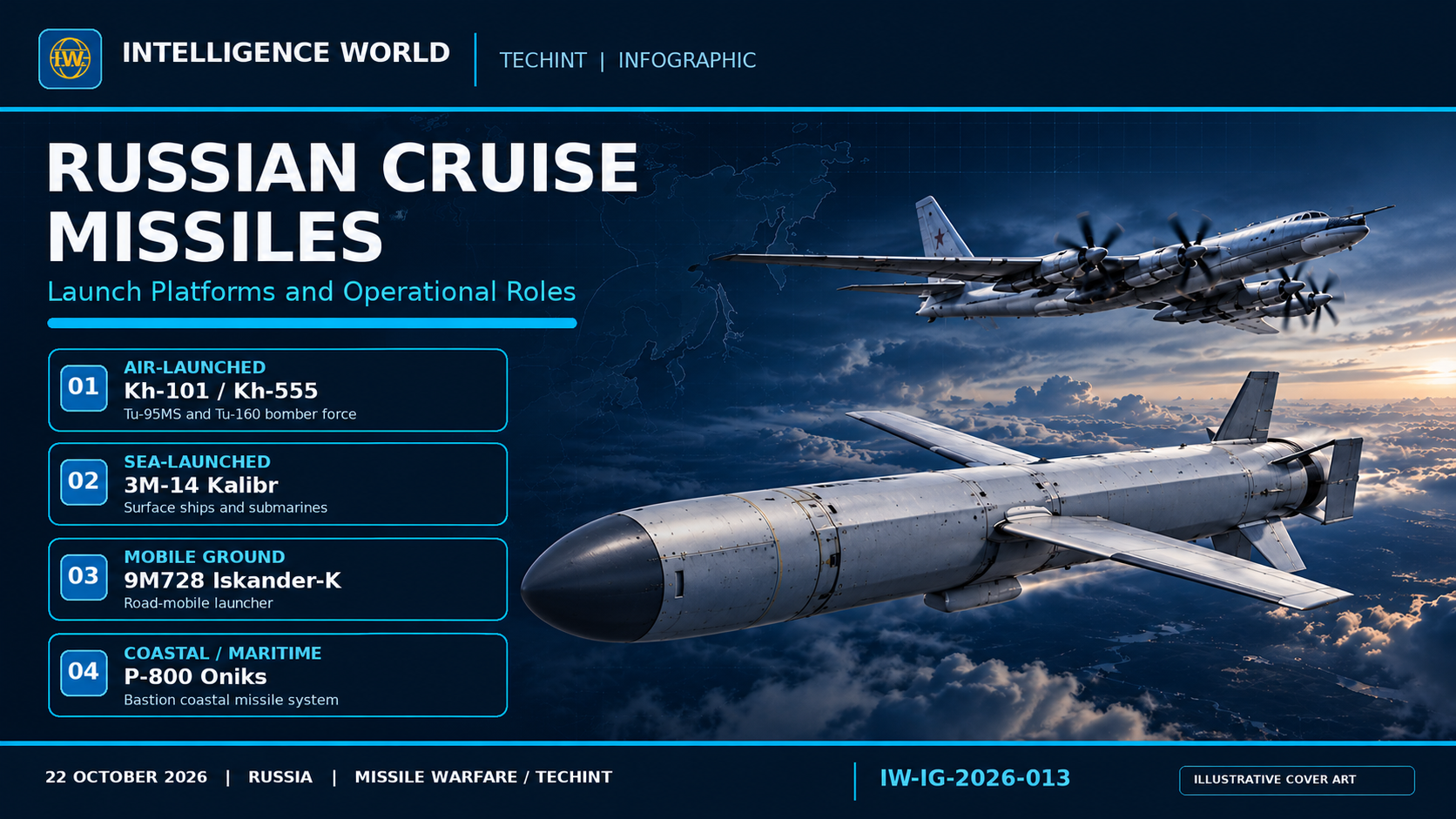
A public-source overview of Russia’s air-, sea-, ground- and coastal-launched cruise-missile families, their launch platforms, reported roles and operational constraints. Range figures and variant-level details remain estimates where open sources do not provide independently confirmed data.
Scope
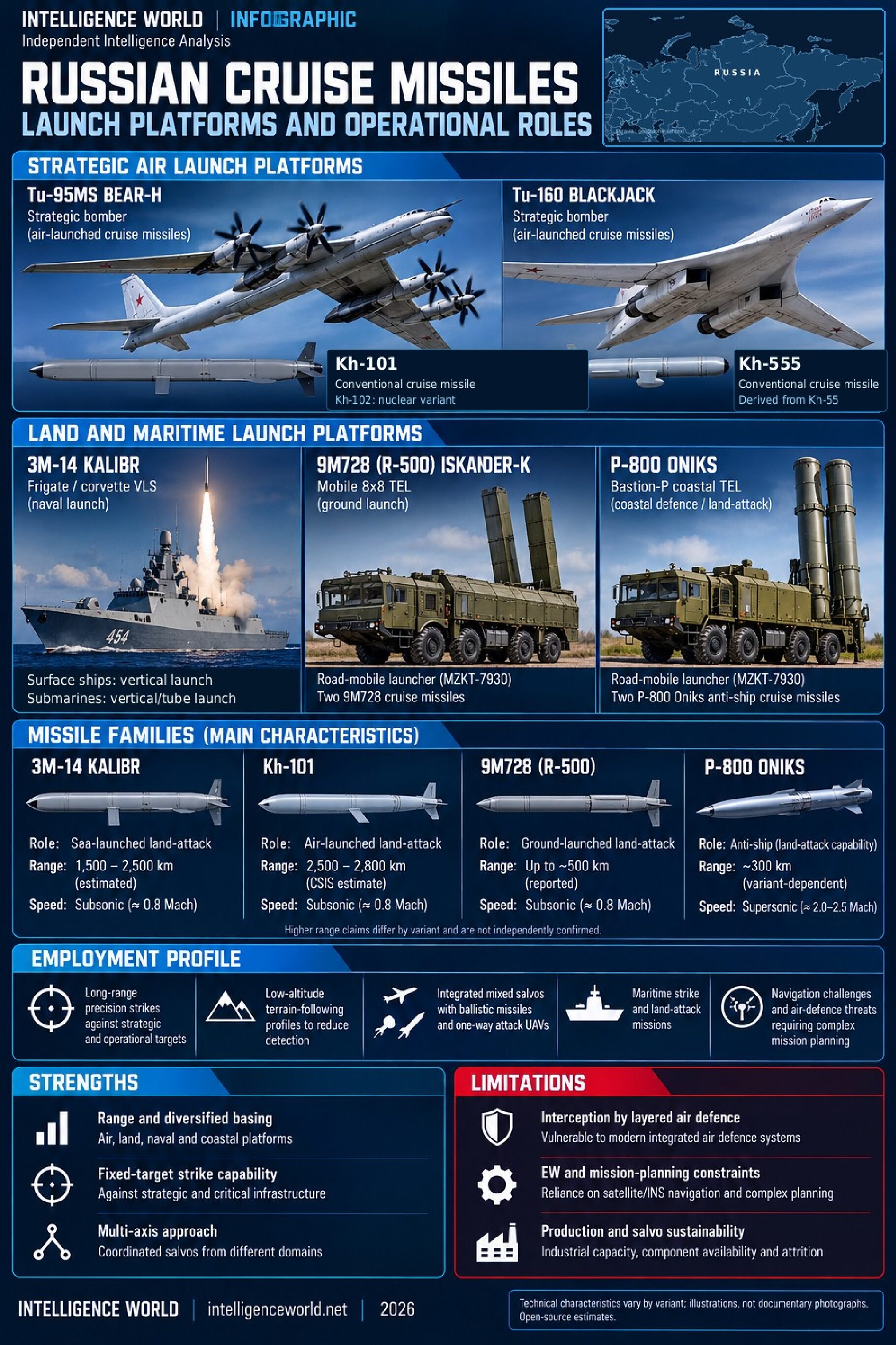
This infographic maps the principal Russian cruise-missile families shown in the graphic to their reported launch platforms and broad operational roles. It covers the air-launched Kh-101/Kh-102 and Kh-555 families; the sea-launched 3M-14 Kalibr; the ground-launched 9M728 (R-500) Iskander-K; and the P-800 Oniks associated with the Bastion coastal missile system. The image is an illustrative synthesis, not a documentary photograph or a complete inventory.
Analytical Focus
Air-launched systems
The Kh-101 is a conventional air-launched cruise missile; the Kh-102 is its nuclear-armed counterpart. The Kh-555 is a conventional member of the Kh-55 family. Tu-95MS and Tu-160 bombers provide long-range launch options, combining missile reach with the carrier aircraft’s range. Practical capability therefore depends on bomber availability, sortie generation, mission planning and access to launch areas.
Sea-launched Kalibr
The 3M-14 is the land-attack member commonly associated with the Kalibr family, distinct from anti-ship variants in the wider family. Ship- and submarine-based launchers distribute the strike function across maritime platforms. Output depends on platform availability, missile stocks, access to suitable launch areas and the ability to coordinate salvos.
Ground-launched Iskander-K
The 9M728 (R-500) is a road-mobile cruise missile associated with the Iskander system. Mobility complicates fixed-site targeting and supports ground-force strike missions. Public range reporting is affected by treaty-era thresholds, variant differences and source uncertainty; the approximately 500 km figure shown is a reported estimate, not a verified universal performance value.
P-800 Oniks and Bastion
P-800 Oniks is principally an anti-ship missile fielded in coastal-defence and naval roles. Some reporting describes land-attack employment or capability, but this should not be conflated with its primary maritime mission. Range depends on variant; export limits and domestic configurations are not directly interchangeable.
Overall Assessment of the Weapon Systems
Russia’s cruise-missile force combines multiple launch domains, mobile basing and weapon families with different target sets. This diversity can complicate warning, air-defence allocation and protection of geographically dispersed infrastructure. It does not by itself establish an ability to penetrate defended airspace reliably or sustain a given strike tempo. Effectiveness depends on missile availability, bomber and naval sortie rates, targeting quality, navigation and route planning, launch geography, replenishment and the defender’s sensor-interceptor network.
Open sources support firmer judgments about system identity, broad role and launch platform than about exact stocks, readiness, mission-capable availability, variant-specific range or sustained salvo capacity. Range values are estimates and should not be treated as directly comparable across variants.
Related Intelligence
- Kh-101: Long-Range Air-Launched Cruise Missile — system profile and employment constraints.
- Russia’s Low-Cost Cruise-Strike Weapons: Banderol and Dan-T — emerging lower-cost strike layer and its relationship to established cruise-missile forces.
Public-source caveat: This profile synthesizes publicly available reporting. The cover uses illustrative concept artwork and is not documentary imagery. Inventory, readiness, mission-capable availability and variant-specific performance remain uncertain where not independently established.
Editorial Signature
Military & Defence Analysis Team – Military Capabilities & Force Structure Analyst