
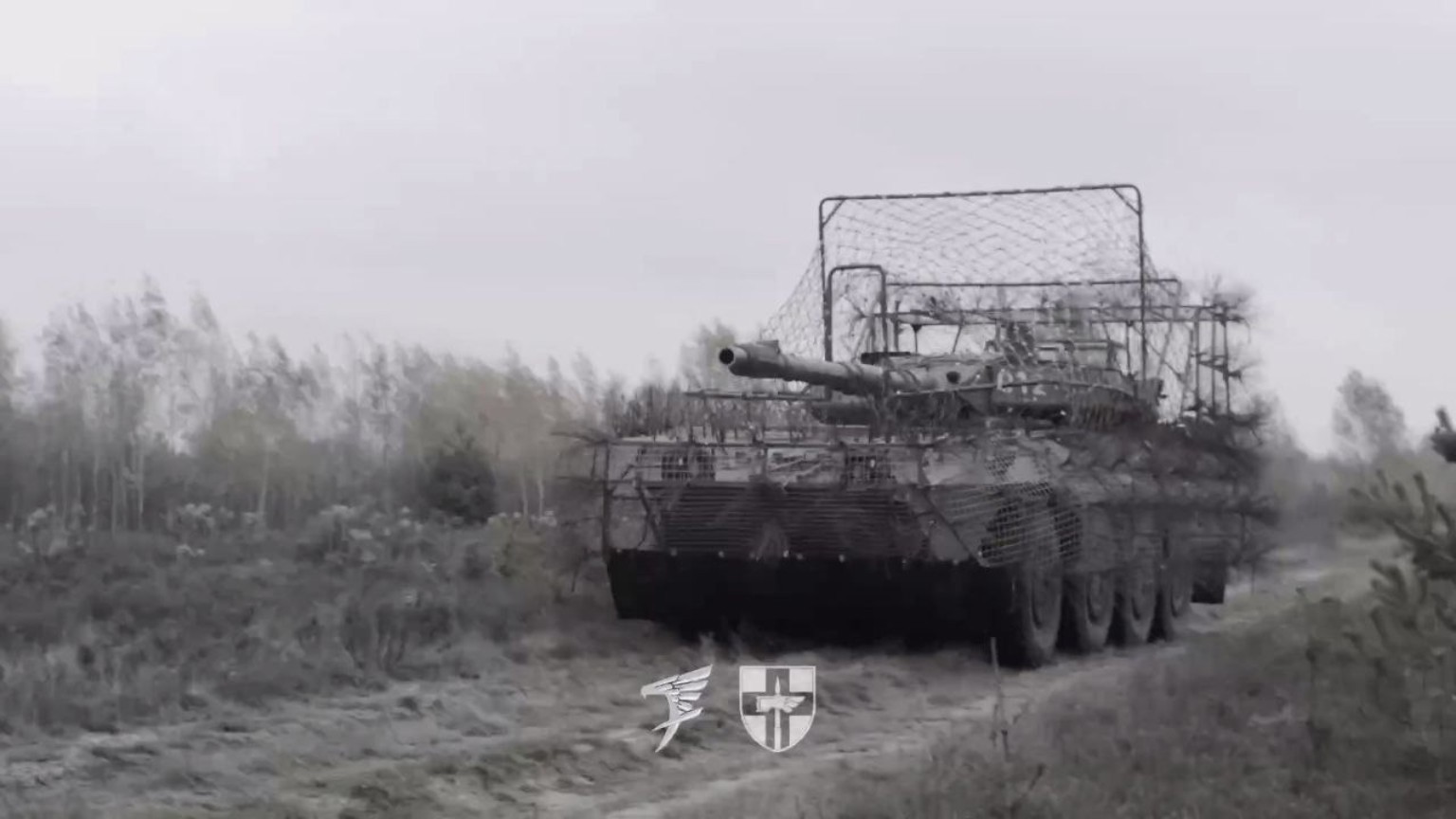
Front view of a Centauro B1 from the 78th Air Assault Regiment. Photo credits: Vodohrai Social and Lifestyle Magazine
Imagery from a Ukrainian air assault unit shows extensive protective modifications to Italian-origin armoured vehicles, illustrating adaptation to the FPV drone threat.
4 November 2026 | Ukraine / Italy | Ground Warfare / Armoured Vehicle Protection
Ukrainian military imagery released in 2025 shows Italian-origin B1 Centauro wheeled fire-support vehicles fitted with extensive overhead netting and spaced metal screens. The modifications reflect field-level adaptation to the persistent threat from FPV drones; their effectiveness has not been independently established.
1. Documented configuration
Material released by the Ukrainian 78th Separate Air Assault Regiment in late October and early November 2025 provided public visual confirmation of B1 Centauro vehicles in Ukrainian service. The vehicles displayed additional protective structures around the hull and turret, including raised mesh canopies and spaced screens. The main gun remained visible beneath the protective framework.

Subsequent Ukrainian military footage released in May 2026 again showed Centauro vehicles with anti-drone modifications during training. The publicly available imagery establishes the presence of locally adapted protection, but neither the total number of vehicles delivered nor their current availability can be determined from it.
2. Operational purpose and limitations
The protective structures are intended to create additional stand-off between attacking drones or their munitions and the vehicle’s primary armour, while some netting arrangements may obstruct a drone before direct impact. Their effect depends on the attacking munition, impact angle and structural integrity of the added protection. No publicly available test data confirm a specific level of protection for the configuration shown.
Such adaptations also introduce potential trade-offs involving access, observation, weapons handling and maintenance. Those effects cannot be quantified from photographs alone. The modifications do not turn the Centauro into a vehicle with comprehensive protection against all types of top-attack weapons.

3. Intelligence World assessment
The case illustrates how Ukrainian units adapt Western-origin armoured vehicles to battlefield threats that have changed substantially since the vehicles entered service. The value of a modification must be judged by its demonstrated performance, ability to be maintained and compatibility with normal crew operations, rather than by the extent of visible protective structures.
Public reporting from May 2026 also described Ukrainian crews employing the Centauro for firing from concealed positions. This suggests adaptation of tactics as well as physical protection, although available footage does not establish the prevalence of such employment across the fleet.
4. Industrial context
In an interview published on 20 October 2026, Ukrainian President Volodymyr Zelensky stated that Ukraine was sharing operational feedback and technical lessons with Italian defence manufacturers and described wider industrial cooperation, including relations with Leonardo.
Those remarks provide context for the exchange of battlefield experience between Ukraine and Italy. They do not establish that the specific Centauro modifications pictured have been evaluated, adopted or incorporated into a Leonardo production programme. A more meaningful indicator would be the public identification of standardised upgrades, trials or support arrangements linked to the Ukrainian experience.
Military & Defence Analysis Team – Ground Warfare Analyst