
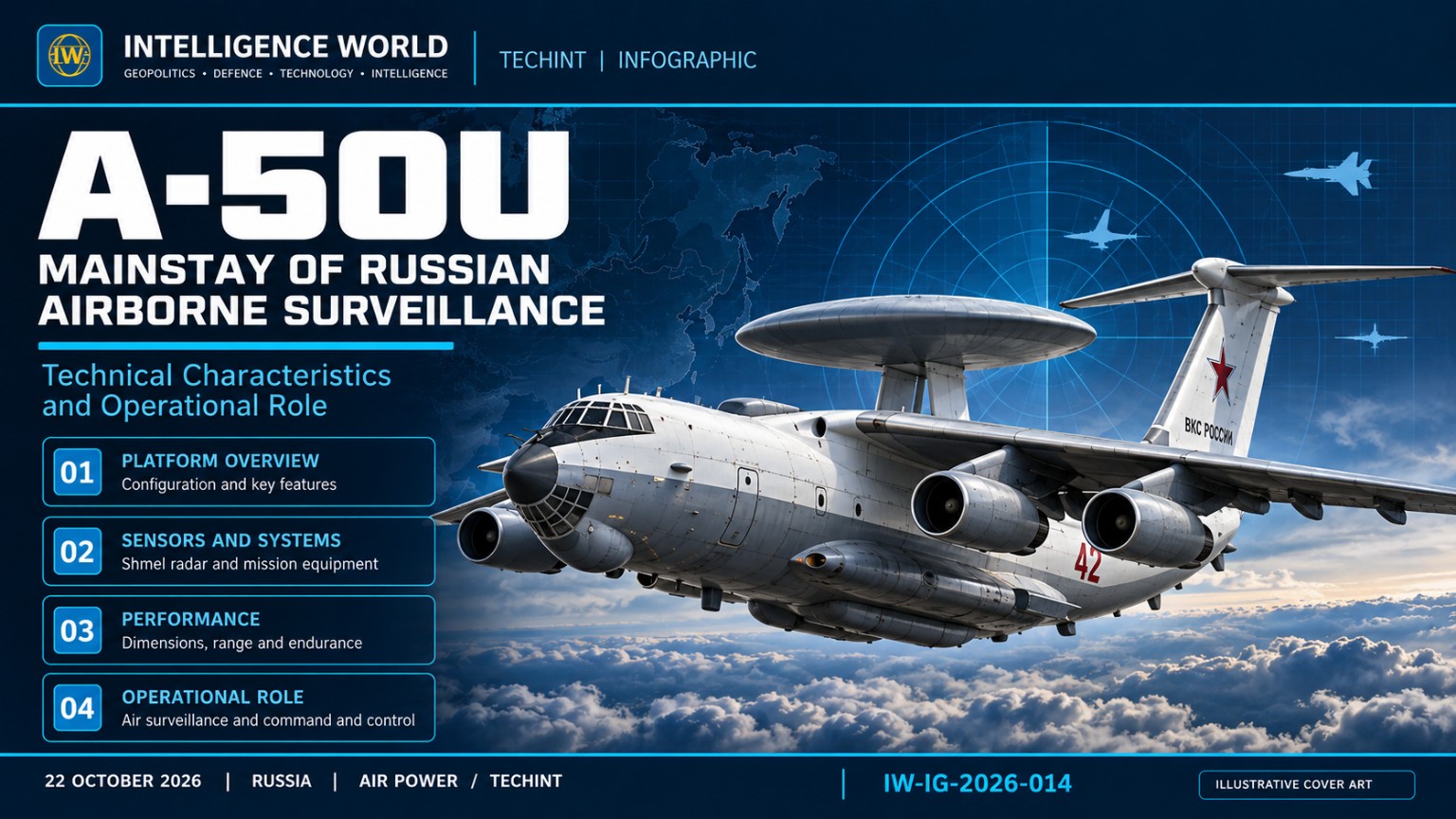
A technical profile of the A-50U, Russia’s modernized airborne early warning and control aircraft. The infographic summarizes its reported mission systems, surveillance and battle-management roles, modernization features, approximate specifications and operational constraints.
Scope
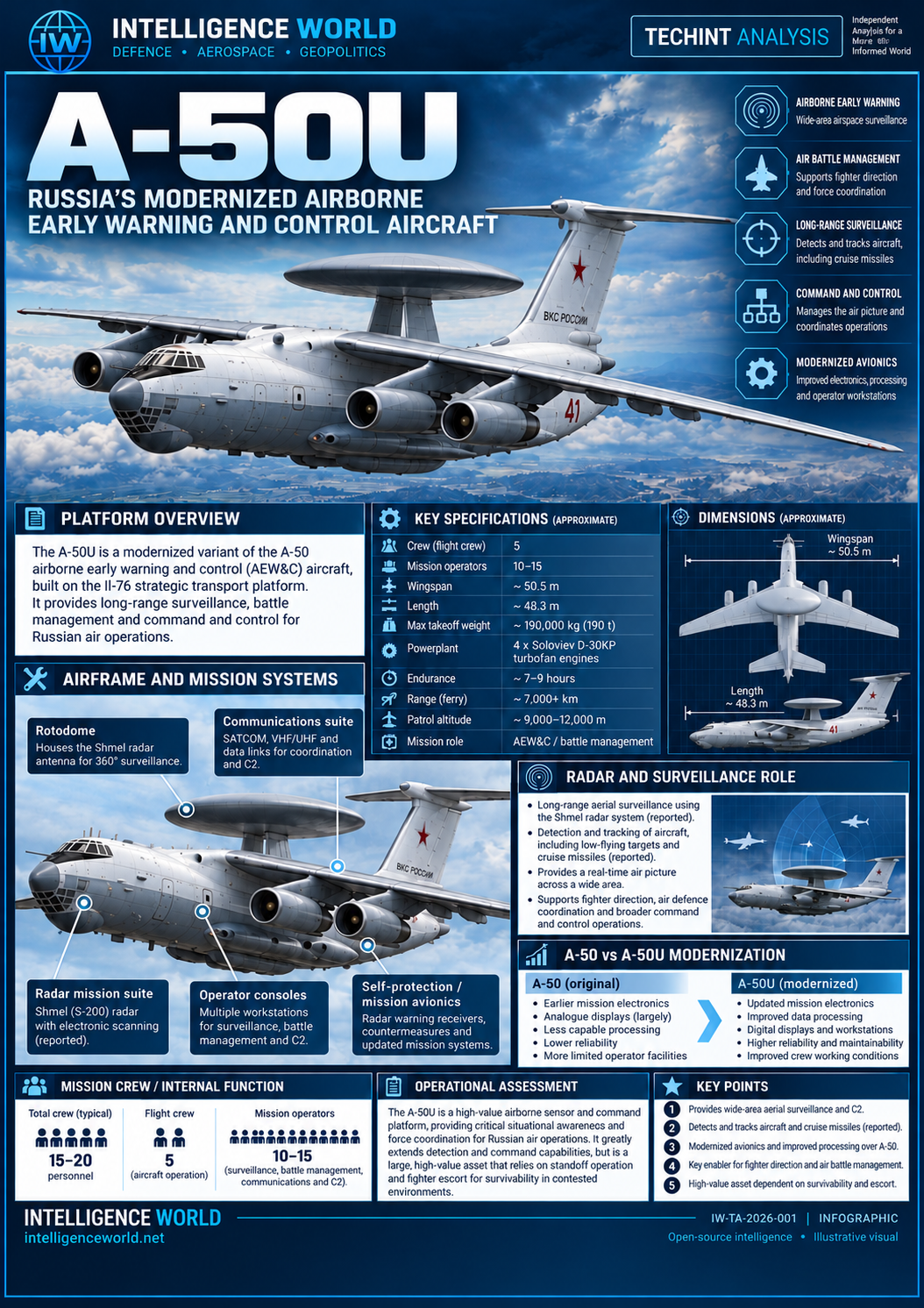
This profile examines the A-50U as a modernized variant of the A-50 airborne early warning and control aircraft, based on the Il-76 transport airframe. It summarizes the reported radar mission suite, communications, operator functions and modernization features. Dimensions and performance figures shown in the infographic are approximate; reported capabilities are not equivalent to independently confirmed operational performance.
Analytical Focus
Airborne surveillance and battle management
The A-50U’s principal function is to extend the air picture beyond the line of sight of ground-based sensors and support command, control and fighter direction. The infographic describes detection and tracking of aircraft, including low-flying targets and cruise missiles, as reported capabilities. The value of the platform depends on the quality and continuity of the sensor-to-command chain, communications links and coordination with other air-defence and aviation elements.
Mission systems and modernization
The aircraft carries the Shmel radar system in its rotodome, with multiple operator workstations for surveillance and battle management. The A-50U modernization is associated with updated avionics, digital displays and improved data processing. The infographic also identifies SATCOM, VHF/UHF communications and data links as part of the coordination suite. Detailed performance and reliability improvements remain difficult to quantify from public information.
Operational employment and constraints
The A-50U is a high-value, crew-intensive platform. Its ability to sustain surveillance depends on mission-capable aircraft, trained crews, maintenance support, communications availability and protection by other forces. Its size and role make survivability a central planning factor; the infographic assesses that operations in contested environments rely on stand-off employment and fighter escort. The number of aircraft available for sustained operations and their readiness cannot be inferred from nominal inventory alone.
Overall Assessment of the Weapon System
The A-50U provides Russia with an airborne sensor and command platform capable of improving situational awareness and coordinating air operations over a wide area. Its operational contribution is not determined by radar performance in isolation: aircraft availability, crew proficiency, communications, data integration, maintenance and survivability shape the effect it can generate. The platform can strengthen air-picture management and fighter direction, but it remains a scarce, high-value asset whose employment in a contested air environment carries significant risk.
Confidence is higher in the aircraft’s broad AEW&C role and modernization purpose than in open-source claims about exact detection performance, readiness rates or sustained mission availability. The specifications in the infographic should therefore be treated as approximate.
Related Intelligence
- Russian Cruise Missiles: Launch Platforms and Operational Roles — related air-surveillance and cruise-missile tracking context.
- Kh-101: Long-Range Air-Launched Cruise Missile — profile of a system identified in the A-50U infographic as a surveillance target.
Public-source caveat: The infographic is an illustrative visual synthesis. Reported radar functions and aircraft specifications are not all independently verified; operational readiness, mission-capable availability and performance in contested conditions remain uncertain.
Editorial Signature
Military & Defence Analysis Team – Air & Air Defense Analyst