
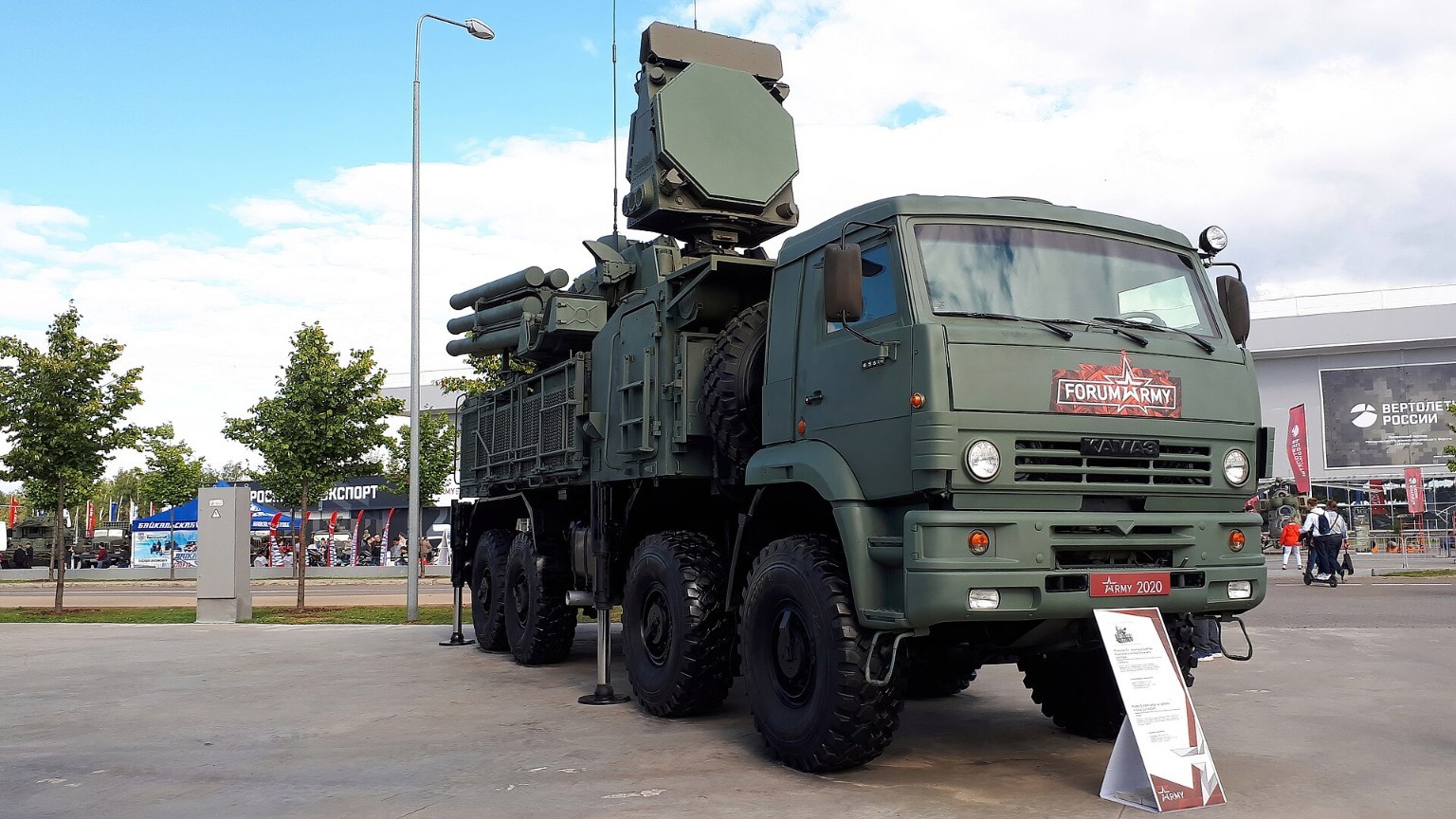
Archive photograph of a Russian Pantsir-family short-range air-defence system displayed at Armiya 2020. This is not an image of the systems reportedly struck in Crimea on 3–4 November 2026. Photo: Kirill Borisenko / Wikimedia Commons, CC BY-SA 4.0.

Ukraine’s General Staff reported strikes against two Pantsir air-defence systems in occupied Crimea during 3–4 November. The attacks form part of efforts to disrupt short-range air defence, but the extent of damage remains unverified.
3–4 November 2026; announcement 4 November
Ground-Based Air Defence / Strike Operations / Crimea — Russia–Ukraine
1. Event overview
On 4 November 2026, the General Staff of the Armed Forces of Ukraine announced that Ukrainian units had struck two Russian Pantsir surface-to-air missile and gun systems in occupied Crimea during 3 November and the following night. The Ukrainian statement identified one target as a Pantsir-S2 and the other more generally as a Pantsir system. It also reported a strike against a Russian firing group in Crimea.
In related operations, Ukrainian forces reported hitting a UAV control post in the Vladivka area of occupied Zaporizhzhia Oblast and a materiel and supply depot near Bilovodsk in occupied Luhansk Oblast. The General Staff separately referenced confirmation of damage from a 26 October strike against a munitions-storage building in the Ohorodne area of Donetsk Oblast; that older incident should not be treated as part of the 3–4 November attack sequence.
The General Staff’s publication confirms that Ukraine claimed the strikes. It does not supply independently verifiable imagery or technical battle-damage assessment sufficient to establish whether either Pantsir was destroyed, disabled or only damaged.
2. Operational significance
The Pantsir family provides mobile short-range air defence using missiles and automatic cannon, normally employed to protect critical facilities, high-value military positions and other elements of an integrated air-defence network. In Crimea, such systems contribute to point defence against Ukrainian unmanned aircraft and other aerial threats.
Striking these assets may increase local defensive pressure and complicate coverage of protected sites. However, the effect depends on the actual state of the systems after the strike, their position within the wider network, the availability of alternate sensors and weapons and the Russian capacity to repair or replace them. None of these factors can be measured from the public announcement alone.
3. Wider strike pattern
The reported attacks on a UAV control post and a logistics facility occurred in other occupied Ukrainian territories. They suggest a broader set of targets across air defence, unmanned operations and sustainment rather than one isolated attack on a single equipment type. No detailed evidence has been released in the cited official statement establishing whether these locations were attacked simultaneously, with the same weapons or by the same unit.
The available information therefore supports the description of a coordinated period of Ukrainian strike activity, not a verified single mission or a fully reconstructed targeting chain. Nor does the report establish how Ukrainian assets penetrated Russian defensive coverage.
4. Intelligence World assessment
If confirmed, the disabling of two Pantsir systems would represent a local reduction in Russian point-defence capacity in Crimea and could create additional protection requirements for nearby facilities. The operational benefit may be temporary if alternate launchers, surveillance assets or repair capabilities can restore coverage.
For now, the confirmed new development is the Ukrainian claim of attacks against two Pantsir systems; the level of damage and longer-term effect on the Russian air-defence posture remain open. Key indicators are authenticated before-and-after imagery, confirmed vehicle identification and location, sustained absence of systems from defended positions and evidence of redeployment or replacement.
Air & Air Defense Analyst