
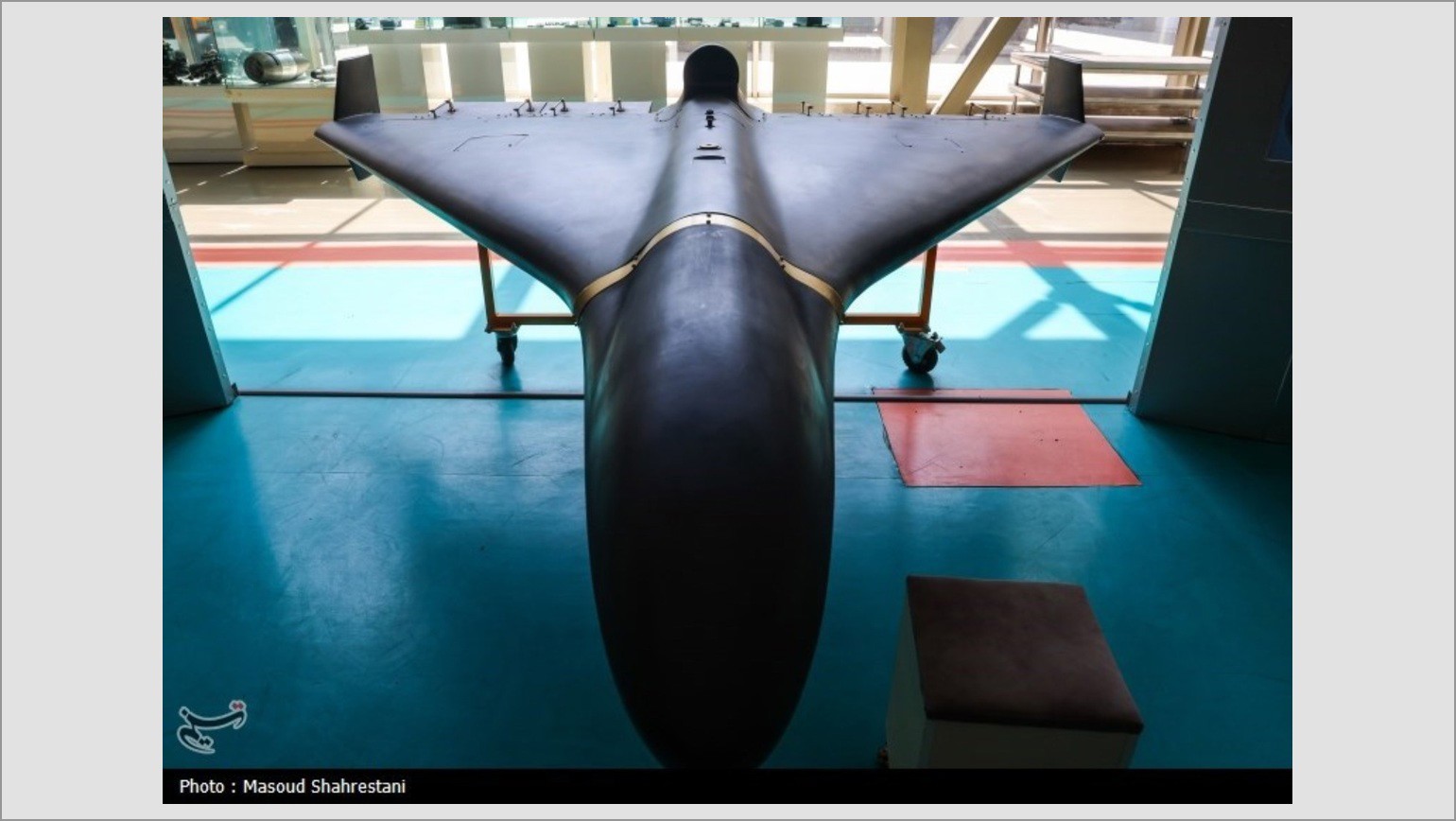
Archive photograph of a Shahed-238 jet-powered UAV on display in Iran in August 2024. Illustrative image; not a photograph of the 4–5 November 2026 attack. Photo: Masoud Shahrestani / Tasnim News Agency, CC BY 4.0. Presented on a neutral 16:9 canvas; the photograph is unaltered.
Ukraine’s Air Force reported 65 jet-powered drones among 128 UAVs launched in an overnight Russian attack. The strike underscores a changing aerial threat mix, but interception figures remain preliminary.
Air Operations / Strike UAVs / Integrated Air Defence — Russia–Ukraine
1. Event overview
Russia launched an overnight air attack on Ukraine beginning at approximately 18:00 local time on 4 November 2026. According to the Ukrainian Air Force’s morning report on 5 November, the attack involved 128 unmanned aerial vehicles, including 65 jet-powered Shahed-type drones, together with two Kh-35 guided missiles reportedly launched from the Black Sea area. Other UAV categories in the reported package included Shahed-type attack drones, Gerbera UAVs and Parodiya decoys. Launch directions identified by Ukrainian authorities included Oryol, Kursk, Millerovo and Primorsko-Akhtarsk in Russia, as well as Russian-held Donetsk, Hvardiiske and Cape Chauda in occupied Crimea.
As of 08:00 on 5 November, Ukraine’s Air Force reported 105 UAVs shot down or suppressed, including 48 jet-powered drones. It also reported strikes by incoming weapons at 18 locations and the fall of intercepted targets or debris at nine. Several UAVs were reportedly still airborne when the figures were issued. These preliminary figures reflect Ukrainian operational reporting and have not been independently reconciled with recovered wreckage or a complete post-strike assessment. No successful interception of either Kh-35 was specified in the cited morning release.
2. Operational significance
The reported presence of 65 jet-powered UAVs is the main development. It places faster attack drones at approximately half of the reported unmanned package, rather than treating them as a marginal component. The data do not, however, identify every jet-powered platform by exact model or demonstrate that all belonged to any newly publicised Geran variant. In particular, it would be incorrect to classify the entire jet-powered group as Geran-5K without independent evidence.
Jet propulsion can reduce the time available to detect, classify and engage an approaching UAV compared with slower propeller-driven systems. The operational effect depends on actual flight speed and altitude, radar coverage, routing, electronic-warfare conditions and available air-defence weapons. Those variables cannot be reconstructed from the aggregate morning figures alone.
3. Air-defence response and limitations
Ukraine’s Air Force described a layered response involving combat aviation, surface-to-air missile units, electronic warfare, unmanned-systems units and mobile fire groups. The reported 105 neutralisations combine physical shoot-downs and suppression; they cannot be interpreted as 105 confirmed kinetic kills. The 48 jet-powered UAVs included in that figure likewise represent a claimed combined outcome, not proof of a specific weapon system’s effectiveness against high-speed drones.
Reported impacts at 18 locations demonstrate that the attack was not fully prevented, but neither the number of targets reaching each site nor the damage attributed specifically to jet-powered UAVs is established. The presence of decoys further complicates any attempt to calculate effectiveness from headline totals.
4. Intelligence World assessment
The composition of the reported attack is more consequential than a simple count of launches. A larger jet-powered component could increase pressure on early warning, engagement sequencing and the cost balance of layered Ukrainian air defence. It may also force more demanding discrimination between higher-speed threats and slower UAVs or decoys within a shared operational picture.
This incident by itself does not demonstrate a sustained new Russian production rate, the confirmed employment of a particular Geran-5 subvariant, or the exhaustion of Ukraine’s interception capacity. Follow-up indicators include repeat attacks with comparable propulsion mixes, independently identified debris, evidence of actual flight profiles, changes in the defensive weapon mix and attributable damage assessments.
Air & Air Defense Analyst