
Image publication: 2 November 2026 | Technical disclosure: 22 October 2026 | Area: Russia–Ukraine | Domain: Missile Warfare / Air Defence / TECHINT
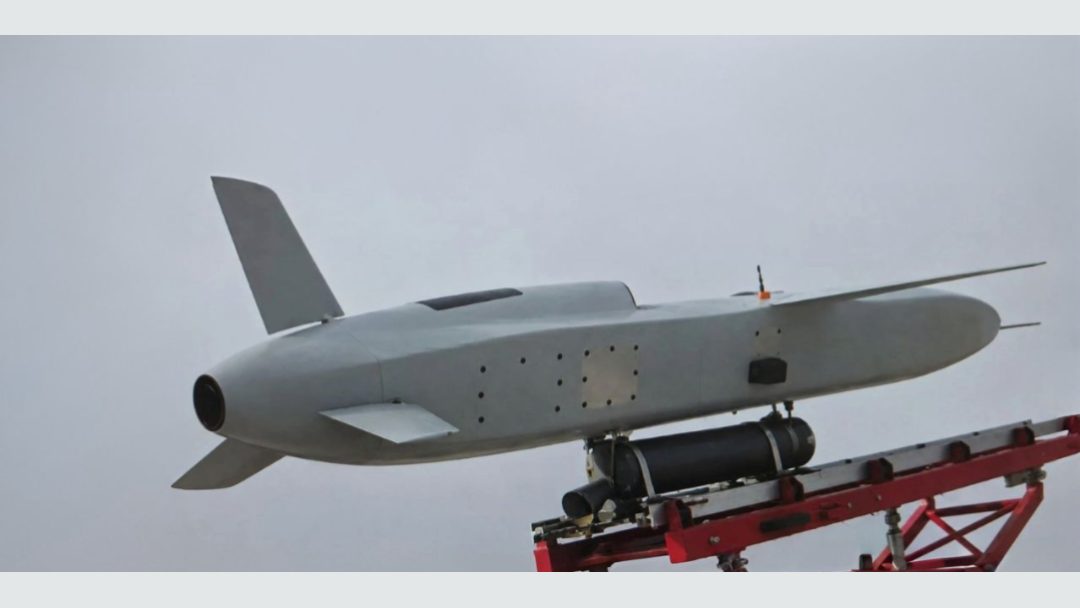
Russian Filin cruise missile shown on a ground-launch structure with an under-fuselage booster in an image circulated on 2 November 2026. The original capture date and location have not been independently verified. Image attributed to Yuri Podolyaka.
Image: Yuri Podolyaka (as credited by Militarnyi, 2 November 2026).
New imagery of the launch configuration
A photograph circulated on 2 November 2026 depicts what is identified as Russia’s Filin cruise missile mounted on a ground-launch structure, with a cylindrical rocket booster secured beneath the fuselage. Russian commentator Yuri Podolyaka was credited with releasing the image. Its original date and location have not been independently established, and the photograph does not show an actual launch or identify the vehicle carrying the launcher.
The image adds a visual reference to technical information released by Ukraine’s Defence Intelligence (HUR) on 22 October. HUR stated that Russian forces began using the Filin against Ukraine in late summer 2026. This reported operational employment is not independently quantified by the photograph.
Reported missile characteristics
According to the HUR technical profile, the Filin is a ground-launched, turbojet-powered cruise missile developed by NPO Molniya. The composite airframe is approximately 3.5 metres long, with a 3-metre wingspan and maximum launch mass of 210 kilograms. HUR identifies 50- and 100-kilogram warhead configurations and reports a solid-propellant booster for initial acceleration before sustained turbojet flight.
The published database lists a range of 600–1,200 kilometres and a maximum speed of up to 800 km/h. These are reported performance figures, not independently demonstrated values. The new image supports the existence of a booster-equipped launch arrangement but does not confirm range, flight profile or accuracy.
Propulsion, navigation and industrial links
HUR attributes the missile to NPO Molniya, identifies an R500 turbojet manufactured by Reynolds LLC and names PLAZ LLC as a producer of onboard equipment. The reported navigation package includes a Chinese-made inertial unit and a 16-channel Kometa satellite-navigation receiver. Ukrainian intelligence also reports foreign electronic components and similarities between some Filin and Harpiya UAV subsystems.
These findings indicate possible reuse of propulsion, electronics and manufacturing approaches across Russian strike systems. They do not establish the Filin’s unit cost, production rate, reliability or the route by which foreign components reached manufacturers.
Intelligence World assessment
The photograph provides a narrower but useful confirmation of the missile’s reported ground-launch architecture. A launch booster could allow deployment without aircraft or ship launch platforms, while the system’s effectiveness would still depend on guidance performance, target intelligence, production capacity and the survivability of launch and support arrangements.
From Ukraine’s air-defence perspective, a compact cruise missile would create an additional detection and engagement requirement if fielded in meaningful numbers. However, neither the image nor the available technical disclosures establish how widely Filin has been deployed or how often it has penetrated Ukrainian defences. Further evidence should include authenticated launch footage, recoverable serial or production markings, repeated strike identification and independent confirmation of the claimed performance envelope.
Based on official Ukrainian defence-intelligence disclosures and corroborating open-source reporting. Reported specifications and operational employment are distinguished from independently verified observations.
Military & Defence Analysis Team – Air & Air Defense Analyst